[ nodar sdk ]

Software Development Kit

Download. Integrate. Deploy.

Build high-performance 3D perception solutions in minutes with NODAR's production-ready stereo engine and your own cameras.
NODAR HDK hardware
NODAR HDK hardware

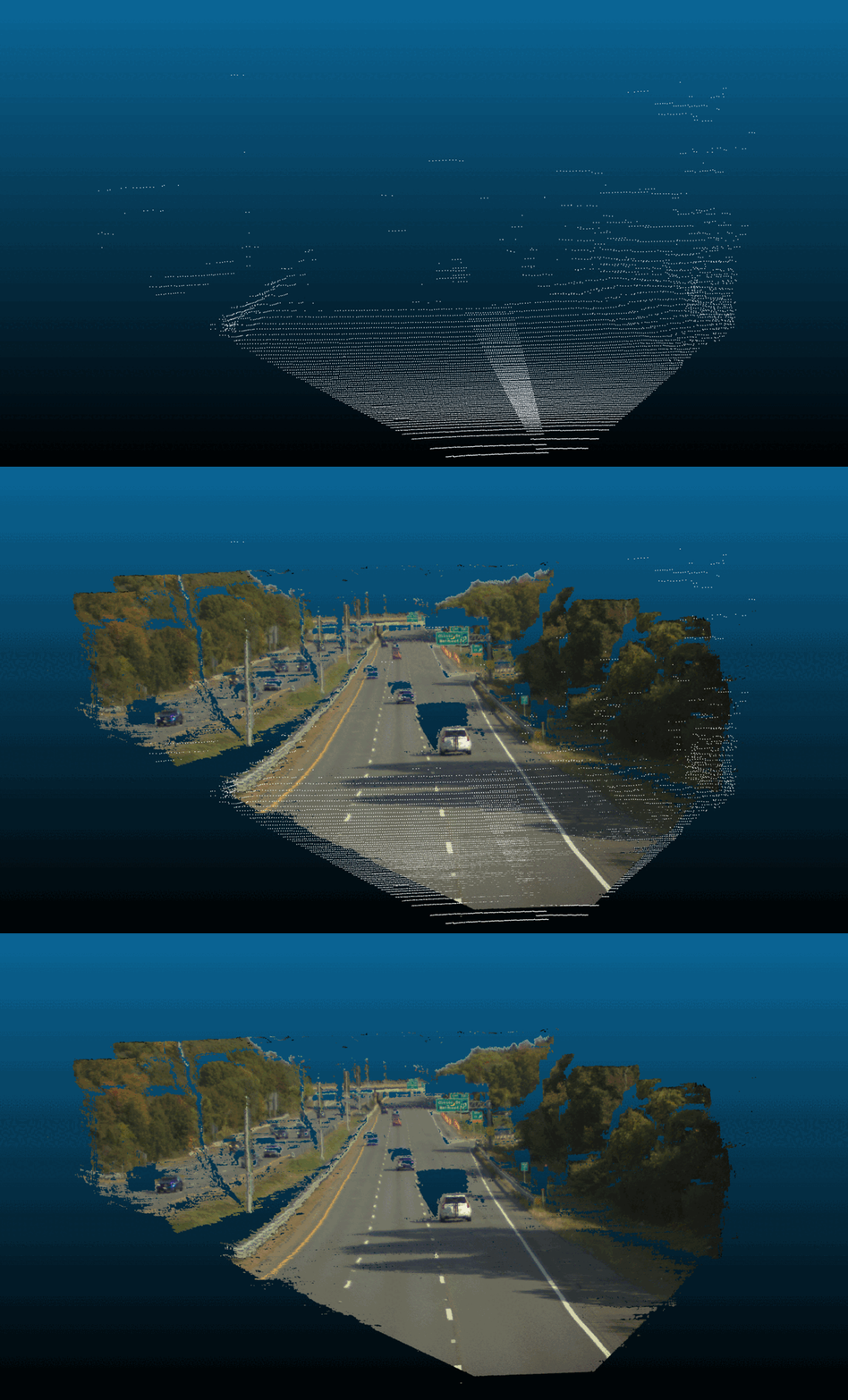
State of the art automotive lidar vs NODAR SDK

State of the art automotive lidar vs NODAR SDK

State of the art automotive lidar vs NODAR SDK

Choose a license or download a free trial and start integrating today.

Production pricing available — with licensing starting as low as $150/stereo camera.


What's Included

  • Patented calibration and stereo matching technology for unparalleled accuracy and long-range stereo camera sensing

  • Occupancy map and object detection GridDetect software (optional)

  • Precompiled Hammerhead SDK for x86 and ARM

  • NODAR Viewer for depth and point-cloud visualization

  • C++ and Python APIs

  • Full developer documentation

Is time a limiting factor?

We can process your images for you, typically in just a week. Send us your stereo camera pair data and we will deliver production-ready depth maps built with the same pipeline powering our SDK.

Superhuman vision.
Unmatched precision.

Superhuman vision.
Unmatched precision.

The NODAR SDK transforms any pair of cameras into a high-performance 3D sensor for autonomous perception with industry-leading range, resolution, and reliability.

NODAR transforms any pair of cameras into a high-performance 3D sensor for autonomous perception with industry-leading range, resolution, and reliability.

The NODAR SDK transforms any pair of cameras into a high-performance 3D sensor for autonomous perception with industry-leading range, resolution, and reliability.

Inputs

Your Existing Cameras

Left Image

Right Image

NODAR SDK

Autocalibration

Compensating for camera vibrations every frame with subpixel accuracy

Stereo Matching

Geometric calculation of depth for every pixel

Occupancy Mapping

Particle filter and fusion layer

Your Computer

(NVIDIA Orin, x86+NVIDIA GPU)

Outputs

Point Cloud (RGBXYZ)

Depth Maps

Point Cloud (RGBXYZ)

Velocity

Recitifed Images

Object List

Occupancy Map

Display your outputs in real time

Download

Integrate

Deploy

Developer Resources

All the resources, tools, and support needed to integrate our cutting-edge stereo vision software into your hardware solutions. Whether you’re building autonomous systems or innovative imaging products, we’re here to help you create the future.

Testimonials

If someone showed us a lidar with such performance, it would be a no-brainer to move forward with integration.

Global Tractor Supplier

In a head-to-head trial with all other multi-camera competitors, NODAR provides the most accurate and only real-time wide-baseline stereo vision system. All other systems compared to NODAR were post-processed due to the high computational load.

Global Automotive OEM

We have been working on stereo for decades and your system is impressive.

Global Automotive Tier 1 Supplier

Applications

Trucks

Ultra long-range, small object detection - detect a 25cm object at 305m to allow for time to stop or avoid.

Passenger Cars

Precise long-range object detection for L3 and above.

Air Mobility

Long-range detection in any direction improves safety.

Heavy Equipment

Resilience to dust and high-vibration, and best-in-class performance in low visibility.

Ferry

Robustness with moving horizon and ultra-fine precision at short distances for docking.

Rail

1000m+ range obstruction detection for collision avoidance and mapping.

Last Mile Delivery

Low-cost, flexible camera mounting, low compute and fine precision - perfect for mobile robots.

Robotaxi

Sensor fusion with lidar provides redundancy while enabling safe highway driving.

Agriculture

Resilience to dust and vibration for autonomous operation, and precision for spout alignment.

NODAR SDK Benefits

The NODAR SDK provides accurate, reliable depth perception in real-world conditions including dust, low light, rain, and fog. Powered by patented auto-calibration algorithms, it transforms stereo image inputs from existing cameras into consistent, high-resolution depth data with minimal setup, enabling scalable, cost-effective integration across diverse platforms and use cases.

Accuracy and Range

High accuracy by computing the true depth of every pixel based on stereoscopic parallax rather than crudely interpolating from known objects.

Low Visibility Performance

High performance in difficult conditions such as high-dust, low-light, rain, fog, and direct sunlight.

Consistency of Results

Patented auto-calibration technology actively compensates for camera perturbations due to wind, road shock, vibration, and temperature.

Ruggedness and Reliability

High longer-term reliability due to continuous calibration.

Easy Installation

Quick setup with a single software installer and thorough documentation.

Value

No need for expensive new hardware - the SDK can be used with existing cameras.
Competitive Analysis

How does NODAR compare to other stereo vision options?

Options that work with generic cameras (not pre-built stereo vision boards with fixed baseline, low-performance global shutters, low resolution, or low-quality optics). There are some free options, but remeber that you get what you pay for!

Accuracy

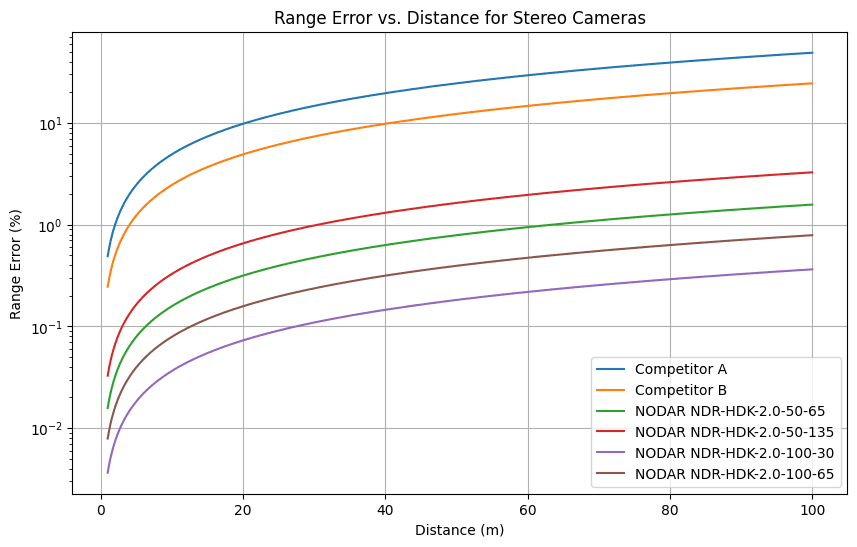
NODAR is orders of magnitude more accurate than any other commercial stereo vision camera.

  • Competitor A: 50-mm baseline, 90-deg FOV, 1280 pixels (H)

  • Competitor B: 100-mm baseline, 90-deg FOV, 1280 pixels (H)

  • NODAR NDR-HDK-2.0-50-65: 500-mm baseline, 65-deg FOV, 2880 pixels (H)

  • NODAR NDR-HDK-2.0-50-135: 500-mm baseline, 135-deg FOV, 2880 pixels (H)

  • NODAR NDR-HDK-2.0-100-30: 1000-mm baseline, 30-deg FOV, 2880 pixels (H)

  • NODAR NDR-HDK-2.0-100-65: 1000-mm baseline, 65-deg FOV, 2880 pixels (H)

Chart showing the ratio of valid points in different weather conditions

Speed

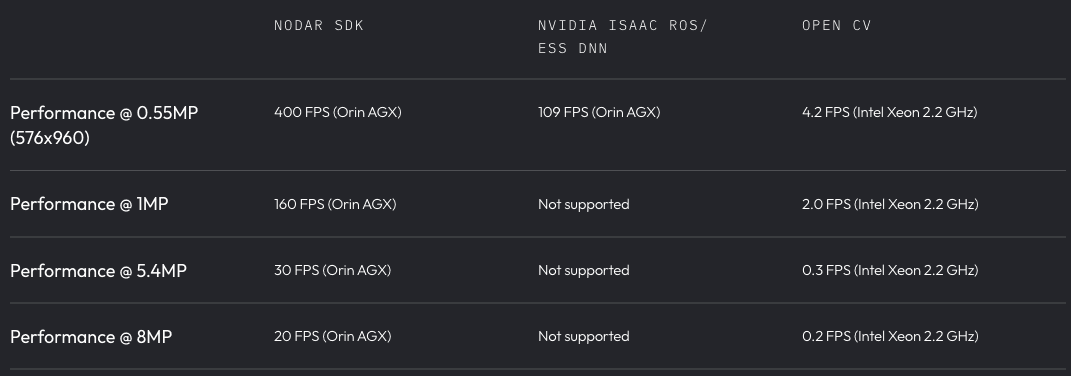
NODAR Hammerhead can process 160M points/s, which is 4-100x faster than other options.

Chart showing the ratio of valid points in different weather conditions

Includes benchmarks for OpenCV computations.

Price

Replace your LiDAR with NODAR and cut sensor costs by 80%. Current LiDAR ($500–$15,000) makes mass-market margins impossible. At $1,000 per unit, autonomy is a luxury experiment. At $150, it’s a global standard.

Competitive Analysis

How does NODAR compare to other stereo vision options?

Options that work with generic cameras (not pre-built stereo vision boards with fixed baseline, low-performance global shutters, low resolution, or low-quality optics). There are some free options, but remeber that you get what you pay for!

NODAR SDK

NVIDIA Isaac ROS/ESS DNN

open cv

License

Commercial

Commercial

Open Source

Primary Use

AV, ADAS, Trucks, Rail, Tractors, Airplanes

Robotics & Warehouse Automation

DIY, Prototyping, Research

Max Detecction Range

1,000m+

Short to Mid
(0.5m – 50m)

Baseline Dependent (Limited)

Frame-byFrame Auto Calibration

Yes
Adjusts every frame to
fix vibration/shocks

No
Relies on rigid mounts; DNN is robust to some error but doesn't "re-calibrate"

No
Requires manual chessboard or offline calibration

Hardware Agnostic?

Yes (Off-the-shelf cameras)

Partially (Optimized for Jetson/NVIDIA)

Yes

Supported Computers

CPU: ARM or x86 GPU: Nvidia

Nvidia Jetson

Mainly x86 support

Core Algorithm

Wide-baseline
Geometry

Deep Learning
(ESS DNN)

SGBM

Accuracy

Excellent

Good

Fair

Computational Speed

Fastest

Middle

Slowest

ROS Support

Yes

Yes

No, not natively

ZMQ Support

Yes

No

No

Vibratation Tolerance

Extreme. Supports unlinked, non-rigid mounts.

Low. Expects a rigid bridge or factory-sealed unit.

None. Any shift breaks the epipolar geometry.

Speed

NODAR Hammerhead can process 160M points/s, which is 4-100x faster than other options.

NODAR SDK

NVIDIA Isaac ROS/ESS DNN

open cv

Performance @ 0.55MP (576x960)

400 FPS (Orin AGX)

109 FPS (Orin AGX)

4.2 FPS (Intel Xeon 2.2 GHz)

Performance @ 1MP

160 FPS (Orin AGX)

Not supported

2.0 FPS (Intel Xeon 2.2 GHz)

Performance @ 5.4MP

30 FPS (Orin AGX)

Not supported

0.3 FPS (Intel Xeon 2.2 GHz)

Performance @ 8MP

20 FPS (Orin AGX)

Not supported

0.2 FPS (Intel Xeon 2.2 GHz)

Includes benchmarks for OpenCV computations.

Price

Replace your LiDAR with NODAR and cut sensor costs by 80%. Current LiDAR ($500–$15,000) makes mass-market margins impossible. At $1,000 per unit, autonomy is a luxury experiment. At $150, it’s a global standard.

NODAR SDK

Automotive LiDAR (Long-Range)

High-End LiDAR (Robotaxi)

Hardware Cost

Low
($40 for 2x 8MP cameras, 100K qty)

Moderate
($500–$1,000)

High
($5,000–$15,000+)

Software/Licensing

Per-Unit (license fee)

Included with hardware

Included with hardware

Unit Cost (Qty 1M)

$190

$600–$1,200

$10,000+

Data Density

~100 Million points/sec

~1–2 Million points/sec

~2–5 Million points/sec

Maintenance

Low (no moving parts)

Moderate (solid-state is better)

High (mechanical spin wears out)

Integration Cost

Moderate (requires calibration/GPU)

High (calibration + power draw)

Extreme (massive compute + cooling)

Production Capability

Infinite (for software)

<100K units/year?

<10K units/year?

Tariffs

None

High (China)

High (90% China)

Accuracy

NODAR is orders of magnitude more accurate than any other commercial stereo vision camera.

  • Competitor A: 50-mm baseline, 90-deg FOV, 1280 pixels (H)

  • Competitor B: 100-mm baseline, 90-deg FOV, 1280 pixels (H)

  • NODAR NDR-HDK-2.0-50-65: 500-mm baseline, 65-deg FOV, 2880 pixels (H)

  • NODAR NDR-HDK-2.0-50-135: 500-mm baseline, 135-deg FOV, 2880 pixels (H)

  • NODAR NDR-HDK-2.0-100-30: 1000-mm baseline, 30-deg FOV, 2880 pixels (H)

  • NODAR NDR-HDK-2.0-100-65: 1000-mm baseline, 65-deg FOV, 2880 pixels (H)

Chart showing the ratio of valid points in different weather conditions

System Requirements

Camera support

Tested between 1MP and 8MP, RGB, LWIR, global and rolling shutter

Lenses

Tested for 5 - 180 degree FOV

compute hardware

NVIDIA GPU (for example, RTX 4090, Geforce 3080, Jetson Orin)

Processor

ARM or x86¹

Specifications

Calibration

Continuous (every frame)

Baseline

Tested up to 5m

Field of view

Tested between 5 and 180 degrees

API

ZMQ and ROS2

Precision

0.2 pixel in disparity

Camera alignment tolerance

+/-3°

Stereo matching algorithm

Deterministic signal processing algorithm

Vibration tolerance

10 pixels per frame

1. Software-only technology enables porting to Intel+GPU or other processors

Competitive Analysis

How does NODAR compare to other stereo vision options?

Options that work with generic cameras (not pre-built stereo vision boards with fixed baseline, low-performance global shutters, low resolution, or low-quality optics). There are some free options, but remeber that you get what you pay for!

NODAR SDK

NVIDIA Isaac ROS/ ESS DNN

open cv

License

Commercial

Commercial

Open Source

Primary Use

AV, ADAS, Trucks, Rail, Tractors, Airplanes

Robotics & Warehouse Automation

DIY, Prototyping, Research

Max Detecction Range

1,000m+

Short to Mid (0.5m – 50m)

Baseline Dependent (Limited)

Frame-byFrame Auto Calibration

Yes
Adjusts every frame to fix vibration/shocks

No
Relies on rigid mounts; DNN is robust to some error but doesn't "re-calibrate"

No
Requires manual chessboard or offline calibration

Hardware Agnostic?

Yes (Off-the-shelf cameras)

Partially (Optimized for Jetson/NVIDIA)

Yes

Supported Computers

CPU: ARM or x86 GPU: Nvidia

Nvidia Jetson

Mainly x86 support

Core Algorithm

Wide-baseline Geometry

Deep Learning (ESS DNN)

SGBM

Accuracy

Excellent

Good

Fair

Computational Speed

Fastest

Middle

Slowest

ROS Support

Yes

Yes

No, not natively

ZMQ Support

Yes

No

No

Vibratation Tolerance

Extreme. Supports unlinked, non-rigid mounts.

Low. Expects a rigid bridge or factory-sealed unit.

None. Any shift breaks the epipolar geometry.

Accuracy

NODAR is orders of magnitude more accurate than any other commercial stereo vision camera.

  • Competitor A: 50-mm baseline, 90-deg FOV, 1280 pixels (H)

  • Competitor B: 100-mm baseline, 90-deg FOV, 1280 pixels (H)

  • NODAR NDR-HDK-2.0-50-65: 500-mm baseline, 65-deg FOV, 2880 pixels (H)

  • NODAR NDR-HDK-2.0-50-135: 500-mm baseline, 135-deg FOV, 2880 pixels (H)

  • NODAR NDR-HDK-2.0-100-30: 1000-mm baseline, 30-deg FOV, 2880 pixels (H)

  • NODAR NDR-HDK-2.0-100-65: 1000-mm baseline, 65-deg FOV, 2880 pixels (H)

Chart showing the ratio of valid points in different weather conditions

Speed

NODAR Hammerhead can process 160M points/s, which is 4-100x faster than other options.

NODAR SDK

NVIDIA Isaac ROS/ ESS DNN

open cv

Performance @ 0.55MP (576x960)

400 FPS (Orin AGX)

109 FPS (Orin AGX)

4.2 FPS (Intel Xeon 2.2 GHz)

Performance @ 1MP

160 FPS (Orin AGX)

Not supported

2.0 FPS (Intel Xeon 2.2 GHz)

Performance @ 5.4MP

30 FPS (Orin AGX)

Not supported

0.3 FPS (Intel Xeon 2.2 GHz)

Performance @ 8MP

20 FPS (Orin AGX)

Not supported

0.2 FPS (Intel Xeon 2.2 GHz)

Includes benchmarks for OpenCV computations.

Price

Replace your LiDAR with NODAR and cut sensor costs by 80%. Current LiDAR ($500–$15,000) makes mass-market margins impossible. At $1,000 per unit, autonomy is a luxury experiment. At $150, it’s a global standard.

NODAR SDK

Automotive LiDAR (Long-Range)

High-End LiDAR (Robotaxi)

Hardware Cost

Low
($40 for 2x 8MP cameras, 100K qty)

Moderate
($500–$1,000)

High
($5,000–$15,000+)

Software/Licensing

Per-Unit (license fee)

Included with hardware

Included with hardware

Unit Cost (Qty 1M)

$190

$600–$1,200

$10,000+

Data Density

~100 Million points/sec

~1–2 Million points/sec

~2–5 Million points/sec

Maintenance

Low (no moving parts)

Moderate (solid-state is better)

High (mechanical spin wears out)

Integration Cost

Moderate (requires calibration/GPU)

High (calibration + power draw)

Extreme (massive compute + cooling)

Production Capability

Infinite (for software)

<100K units/year?

<10K units/year?

Tariffs

None

High (China)

High (90% China)

More questions?

Check out the FAQ page.
Or reach out to a NODAR expert.

Feature title.

This is a feature description spanning a couple of lines.

Feature title.

This is a feature description spanning a couple of lines.